30 Common HTML Elements
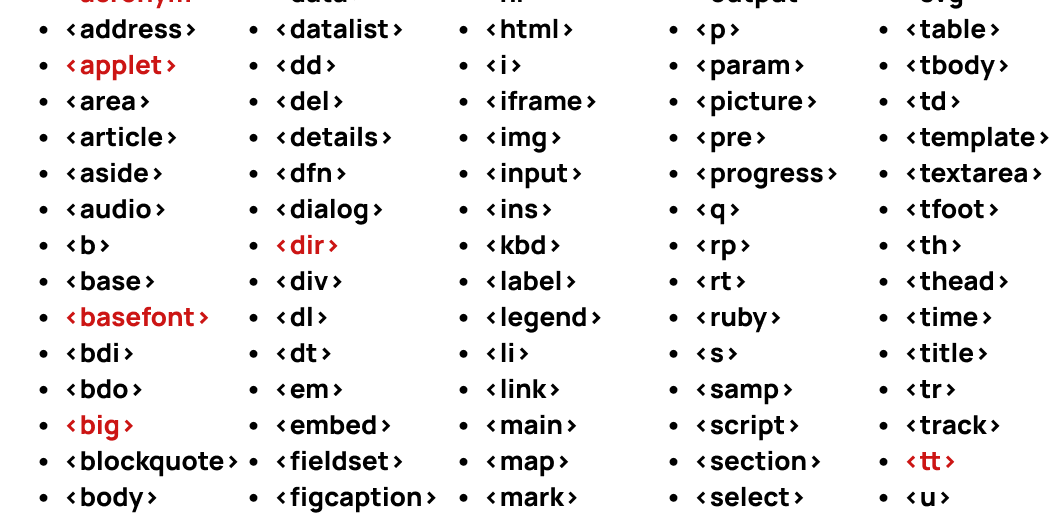
- <!DOCTYPE>
- Defines the document type and version of HTML.
- <html>
- Root element of an HTML document.
- <head>
- Contains meta-information about the document.
- <title>
- Sets the title of the webpage (shown in browser tab).
- <meta>
- Provides metadata like character set and page description.
- <link>
- Links external resources like CSS files.
- <style>
- Embeds internal CSS styles.
- <script>
- Embeds or links to JavaScript code.
- <body>
- Contains all the visible content of the webpage.
- <h1> to <h6>
- Heading tags, from most to least important.
- <p>
- Paragraph tag for blocks of text.
- <a>
- Anchor tag used to create hyperlinks.
- <img>
- Embeds an image into the page.
- <br>
- Inserts a line break.
- <hr>
- Inserts a horizontal rule (line).
- <ul>
- Creates an unordered (bulleted) list.
- <ol>
- Creates an ordered (numbered) list.
- <li>
- List item tag, used inside <ul> or <ol>.
- <div>
- Generic container for content or layout.
- <span>
- Inline container for text or styling.
- <table>
- Creates a table layout.
- <tr>
- Table row.
- <td>
- Table data cell.
- <th>
- Table header cell.
- <form>
- Creates a form for user input.
- <input>
- Input field in a form.
- <label>
- Label for a form element.
- <button>
- Clickable button element.
- <section>
- Defines a section of content.
- <footer>
- Defines the footer for a page or section.
List of HTML elements generated from ChatGPT